
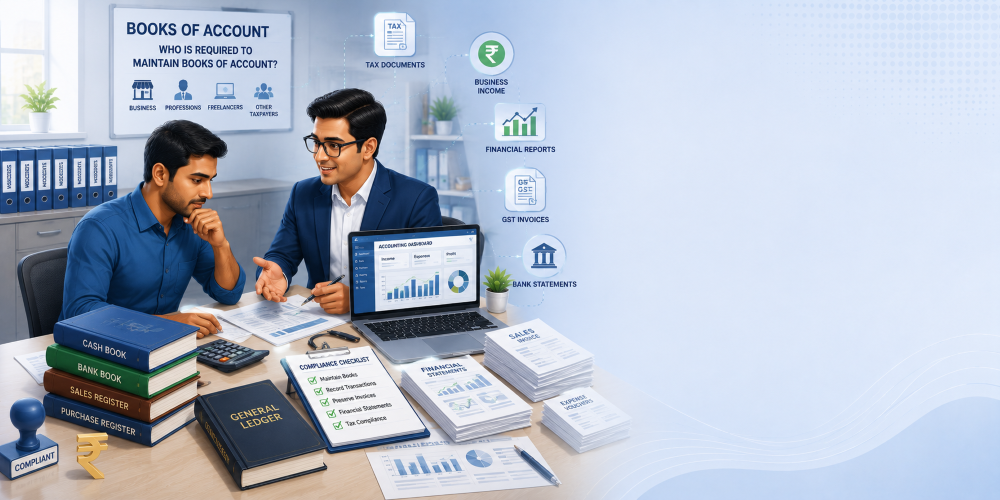
One of the most commonly ignored compliance requirements among small business owners and independent professionals is the obligation to maintain proper books of account. Many assume that as long as they file their income tax return honestly, what records they maintain or do not maintain along the way does not matter. This assumption is incorrect, and it can be expensive. Section 44AA of the Income Tax Act, 1961, along with Rule 6F of the Income Tax Rules, lays down a clear legal framework specifying exactly who must maintain books of account, what those books must contain, where they must be kept, and for how long. This article explains each of these requirements in simple terms, covering professionals, small business owners, and others who may be wondering whether this obligation applies to them.
Why Books of Account Matter Under Income Tax Law
The income tax department does not simply take a taxpayer’s word for the income declared in a return. The assessment process allows the department to verify the figures declared by examining the underlying books and records of the business or profession. Without proper books, there is nothing for either the taxpayer or the department to verify against. This is why the law mandates that certain categories of taxpayers maintain specified records throughout the year, rather than trying to reconstruct figures at the time of filing.
Beyond compliance, well-maintained books serve the taxpayer’s own interests. They make it easier to prepare an accurate return, support deductions claimed, respond to notices without panic, and demonstrate financial credibility to banks and lenders. For a small business or professional practice in Gurgaon or anywhere else in the country, proper bookkeeping is genuinely useful on a day-to-day basis, quite apart from the legal requirement.
Two Categories of Taxpayers Under Section 44AA
Section 44AA draws a clear distinction between two groups: specified professionals, and everyone else carrying on a business or non-specified profession. The rules for each group are different.
Category 1: Specified Professionals
Section 44AA(1) and Rule 6F cover those carrying on a specified profession. The professions listed are legal practice, medical practice, engineering, architecture, accountancy, technical consultancy, interior decoration, authorised representatives, and film artists. The Central Board of Direct Taxes can also add further professions through official notification.
Film artists under Rule 6F include a wide range of individuals, specifically actors, cameramen, directors, music directors, art directors, dance directors, editors, singers, lyricists, story writers, screenplay writers, dialogue writers, and dress designers. Many of these professionals do not realise they fall within a legally specified category for bookkeeping purposes.
Rule 6F provides a practical threshold: a specified professional whose total gross receipts did not exceed Rs 1,50,000 in any one of the three immediately preceding years is not required to maintain the prescribed books. For a newly set-up profession, the exemption applies if receipts for the current year are not likely to exceed Rs 1,50,000. Above this threshold, the full bookkeeping obligation applies.
What Books Must Specified Professionals Maintain
Rule 6F(2) prescribes the exact records required. These are a cash book recording all cash receipts and payments day to day, showing the cash balance at the end of each day or at the end of a period not exceeding one month; a journal, if accounts are maintained on the mercantile system of accounting; a ledger summarising all transactions under individual account heads; carbon copies or counterfoils of all bills and receipts issued by the professional, serially numbered, with no requirement for amounts under Rs 25; and original bills received for expenses incurred, or where no bill is issued and the amount does not exceed Rs 50, a payment voucher prepared and signed by the professional.
Doctors have an additional requirement. Under Rule 6F(3), medical practitioners must also maintain a daily case register in Form No. 3C and an inventory of drugs, medicines, and consumable accessories as on the first and last day of each financial year.
Additional Requirements for Medical Professionals
Doctors and other persons carrying on a medical profession have an additional obligation under Rule 6F(3), over and above the standard set of books required for all specified professionals. They must also maintain a daily case register in Form No. 3C, which is a prescribed format capturing information about each patient seen. They must also maintain an inventory, under broad heads, of the stock of drugs, medicines, and consumable accessories used in the practice, recorded as on the first and the last day of the financial year. These additional requirements reflect the fact that a medical practice involves physical stock of consumables that directly affects both income computation and professional accountability.
Category 2: Business Owners and Non-Specified Professions
For those carrying on a business, or a profession not listed under Section 44AA(1), the obligation to maintain books is linked to crossing certain thresholds rather than applying automatically.
For individuals and HUFs, books must be maintained if income from business or profession exceeds Rs 2,50,000, or if total sales, turnover, or gross receipts exceed Rs 25,00,000, in any one of the three preceding years. For a newly set-up business, the same limits apply to expected figures for the current year.
For companies, partnership firms, LLPs, and other non-individual entities, the thresholds are lower. Books must be maintained if income exceeds Rs 1,20,000 or turnover exceeds Rs 10,00,000 in any of the three preceding years.
For this second category, no specific books are prescribed by Rule 6F. The law requires only that whatever records are maintained must be sufficient to enable the Assessing Officer to compute the taxpayer’s total income accurately.
The Relationship Between Section 44AA and Presumptive Taxation
One of the most useful things to understand is how the bookkeeping obligation under Section 44AA interacts with the presumptive taxation schemes under Sections 44AD and 44ADA.
If a business owner declares income at 8 or 6 percent of turnover under Section 44AD, or a professional declares income at 50 percent of gross receipts under Section 44ADA, they are not required to maintain the books of account that would otherwise be mandatory under Section 44AA. The presumptive scheme essentially buys them an exemption from bookkeeping, which is a major part of its practical appeal for smaller taxpayers.
However, this exemption disappears if the taxpayer steps outside the presumptive scheme. If a taxpayer under Section 44AD declares profit below the required 8 or 6 percent in a later year, and their income exceeds the basic exemption limit, they become required to maintain full books under Section 44AA(2) and get them audited under Section 44AB for that year. Similarly, a professional under Section 44ADA who declares profit below 50 percent of receipts, and whose income exceeds the basic exemption limit, must maintain the books prescribed under Section 44AA(1) and submit to an audit. This is what makes the decision to step out of the presumptive scheme a considered one rather than a casual choice.
Where Books Must Be Kept and For How Long
Rule 6F(4) requires that books be maintained at the place where the profession is actually carried on. If the profession is carried on at more than one location, books must be kept at the principal place of practice, unless separate books are maintained for each location, in which case those books may be kept at the respective places.
Rule 6F(5) requires that books be retained for six years from the end of the relevant assessment year. For FY 2025-26 (AY 2026-27), this means retaining records until 31st March 2033. If an assessment is reopened under Section 147, books must continue to be kept until the reopened assessment is completed, regardless of where the six-year period stands at that point.
The Finance Act 2025 has explicitly permitted digital record-keeping, so accounting software and cloud-based platforms are acceptable, provided the records remain accessible and verifiable when required.
The Penalty for Not Maintaining Books of Account
If a taxpayer who is required to maintain books of account under Section 44AA fails to do so, a penalty can be levied under Section 271A of the Income Tax Act. The maximum penalty that can be imposed is Rs 25,000 per assessment year of non-compliance. However, if the taxpayer can demonstrate a reasonable cause for the failure, no penalty is levied.
Beyond the direct penalty, the practical consequences of not having proper books are often more damaging than the fine itself. Deductions claimed for business expenses may be disallowed entirely if there are no supporting records. The department may conduct a more intrusive assessment and may estimate income based on available information rather than the figures declared in the return. And in the event of any future dispute or notice, the absence of records leaves the taxpayer without any documentary defence.
A Practical Summary of Who Must Maintain What
Understanding this section can feel complicated because the rules differ across different types of taxpayers. A simple way to think about it is as follows. If you are a specified professional, such as a doctor, lawyer, engineer, architect, or accountant, and your gross receipts have exceeded Rs 1,50,000 in any of the last three years, you must maintain the full set of books prescribed under Rule 6F, including a cash book, journal, ledger, copies of bills issued, and original bills received. If you are a doctor, you have the additional requirement of a daily case register and stock inventory.
If you are an individual or HUF running a business or non-specified profession, and your profit has exceeded Rs 2,50,000 or your turnover has exceeded Rs 25,00,000 in any of the last three years, you must maintain books sufficient to support your income computation, even though no specific format is prescribed. If you are a company or firm in the same position but with lower thresholds of Rs 1,20,000 income or Rs 10,00,000 turnover, the same applies.
If you have opted for presumptive taxation under Section 44AD or 44ADA and declared the required percentage of income, you are exempt from the Section 44AA bookkeeping obligation, unless you step out of the scheme and declare a lower profit with income above the basic exemption limit.
Many professionals and business owners in Gurgaon’s commercial areas, particularly those who have grown beyond the very small scale but have not yet set up formal accounting systems, find themselves in the middle ground where the obligation has arrived before the systems have. A CA in Gurgaon can help assess exactly where a particular practice or business stands relative to these thresholds and set up a simple, compliant record-keeping system that satisfies the law without creating unnecessary administrative burden.
Frequently Asked Questions
1. Does a salaried person need to maintain books of account under Section 44AA? No. Section 44AA applies only to those carrying on a business or profession. A salaried individual with no business or professional income has no obligation to maintain books of account under this section.
2. What happens if I maintain books of account but not in the prescribed format? For specified professionals required to maintain the books listed under Rule 6F, maintaining incomplete or unspecified records may be treated as non-compliance, and a penalty under Section 271A may be levied. For the second category of business taxpayers, where no specific format is prescribed, the key test is whether the records maintained are sufficient to allow the Assessing Officer to compute total income.
3. Can I maintain digital books of account instead of physical records? Yes. The Finance Act 2025 has explicitly permitted digital record-keeping under Section 44AA, and electronic records maintained through accounting software or cloud-based platforms are acceptable as long as they can be made accessible in a readable and verifiable format when required.
4. If I use Section 44ADA, do I still need to maintain books of account? Not as long as you declare income at 50 percent or more of gross receipts and your receipts stay within the applicable limit. If you declare a lower profit and your total income exceeds the basic exemption limit, or if your receipts exceed the limit altogether, the obligation under Section 44AA is restored and an audit also becomes necessary.
5. For how many years must I keep my books of account? Six years from the end of the relevant assessment year. For FY 2025-26 (AY 2026-27), this means retaining books until 31st March 2033. If an assessment is reopened under Section 147, books must be retained until the reopened assessment is completed, regardless of the six-year period.
6. What is the penalty for not maintaining books of account? A penalty of up to Rs 25,000 per assessment year can be levied under Section 271A for failure to maintain the required books. The penalty may not apply if the taxpayer demonstrates a reasonable cause for the failure, but the practical consequences of missing records, such as disallowance of deductions and estimated income assessment, are often more damaging than the fine itself.
7. Do doctors need to maintain any additional records beyond the standard books? Yes. Under Rule 6F(3), medical practitioners must also maintain a daily case register in Form No. 3C and an inventory of drugs, medicines, and consumable accessories as on the first and last day of each financial year, in addition to the cash book, journal, ledger, and bill copies required of all specified professionals.
8. I am a freelance content writer. Do I fall under Section 44AA? Content writing is not a profession currently listed in the specified category under Section 44AA(1) or Rule 6F. It would therefore fall under Section 44AA(2) as a non-specified profession, and the bookkeeping obligation would apply only if income exceeds Rs 2,50,000 or turnover exceeds Rs 25,00,000 in any of the three preceding years, in the case of an individual. If your receipts are within the Section 44ADA limit and you are eligible for that scheme, opting into it removes the bookkeeping obligation entirely, subject to the conditions of that scheme being met. Whether content writing qualifies as a specified profession under 44ADA is itself a question worth clarifying, as discussed in the Section 44ADA article on this website.
9. Should I consult a CA before deciding whether I need to maintain books of account? For anyone in a borderline situation, such as a professional whose receipts are just above or below the Rs 1,50,000 threshold, or a business whose turnover is near the applicable limit, consulting a CA in Gurgaon before the start of the financial year is a sensible step. Getting the compliance structure right from the beginning of the year is far simpler than trying to reconstruct records or correct non-compliance after it has already occurred.
Disclaimer: This article is for informational purposes only and should not be considered legal, tax, or professional advice. Readers are advised to consult a professional before taking any action based on this information. Suggestions, corrections, and feedback are always welcome.