
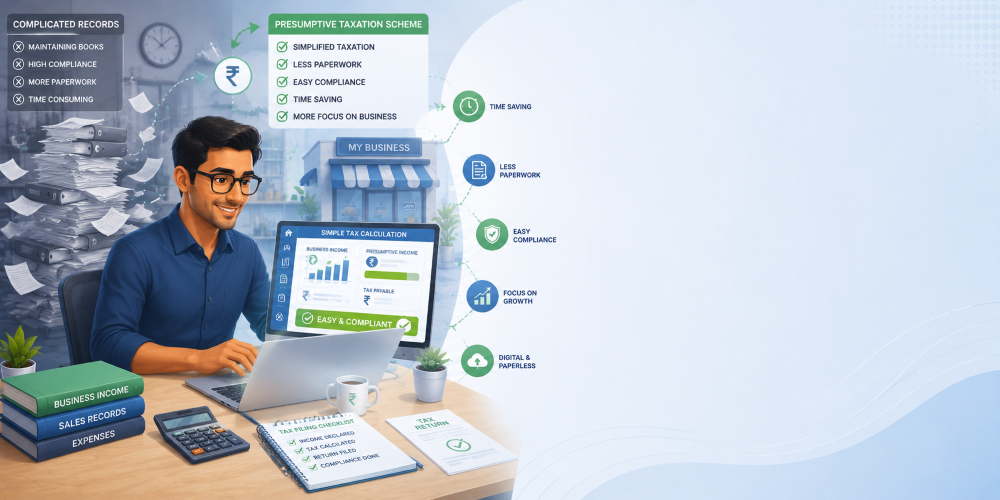
Doctors, lawyers, engineers, architects, chartered accountants, and a wide range of other professionals often run their practice as a sole proprietor, billing clients directly for their services. For many of them, maintaining detailed books of account and getting those accounts audited every year is a genuine compliance burden, disproportionate to the size of their practice. Section 44ADA of the Income Tax Act exists specifically to ease this burden. It allows eligible professionals to declare a fixed percentage of their gross receipts as taxable income, without maintaining detailed accounts and without an audit, as long as certain conditions are met. This article explains, in simple language, who can use Section 44ADA, how the tax is calculated, the turnover limits for this year, and the rules every professional should understand before opting in. Many independent professionals working in and around Gurgaon, from consultants to medical practitioners, rely on this scheme to keep their annual tax filing manageable, so understanding it properly is worth the time.
What Is Section 44ADA
Section 44ADA is a presumptive taxation scheme designed specifically for professionals, as distinct from Section 44AD, which applies to small businesses. Under this scheme, instead of computing actual profit by tracking every fee received and every expense incurred, the law simply presumes that 50 percent of your gross receipts is your taxable profit. The remaining 50 percent is treated as having already covered all your business expenses, whether that assumption matches your actual cost structure or not. If your real expenses are genuinely low, this scheme works very much in your favour. If your practice has high genuine costs, such as a large support staff or expensive equipment, it is worth comparing this against filing under the normal method before deciding.
Who Can Use Section 44ADA
The scheme is available only to a resident individual or a partnership firm, excluding Limited Liability Partnerships. Companies, LLPs, and non-resident professionals cannot use this section.
Beyond this, the professional must be engaged in one of the professions specifically referred to under Section 44AA of the Income Tax Act. This is an important detail, since Section 44ADA does not apply to every kind of self-employed person, only to those falling within this specified list. The professions covered include legal practice, medical practice, engineering, architecture, accountancy, technical consultancy, interior decoration, and any other profession that the Central Board of Direct Taxes has separately notified by official gazette. Over time, this notified list has come to include several other categories, including film professionals such as producers, directors, actors, editors, cameramen, music directors, and screenplay writers, along with company secretaries and a few other specified roles.
This distinction matters because many self-employed individuals, particularly those in newer fields like digital marketing, content creation, or general business consulting, sometimes assume they automatically qualify for Section 44ADA simply because they are professionals in a broad sense. Strictly speaking, eligibility depends on whether the specific profession is one that falls within the categories listed under Section 44AA or has been separately notified. Where there is doubt about whether a particular line of work qualifies, it is worth getting a clear answer before filing under this section, since using the wrong presumptive scheme can itself become a compliance problem later.
Turnover Limits for FY 2025-26 (AY 2026-27)
The standard limit under Section 44ADA is gross receipts up to Rs 50 lakh in the financial year. This limit increases to Rs 75 lakh where the amount received in cash during the year does not exceed 5 percent of total gross receipts, meaning at least 95 percent of receipts must come through banking or digital channels such as account payee cheques, demand drafts, NEFT, RTGS, UPI, or other electronic modes.
The law is specific about what does not count as a digital receipt for this purpose. A cheque or bank draft that is not an account payee instrument is treated as a cash receipt for calculating this 5 percent threshold, even though it technically moves through a bank. This is a detail that catches several professionals off guard, particularly those who receive payment through ordinary bearer cheques from a few clients and assume this automatically counts toward their digital receipts.
These limits have remained unchanged for FY 2025-26 (AY 2026-27) compared to the previous year, so professionals already familiar with the Rs 50 lakh and Rs 75 lakh thresholds from last year’s filing can continue working with the same figures this season.
How Tax Is Calculated Under Section 44ADA
Under this scheme, 50 percent of your total gross receipts for the year is deemed to be your taxable profit from the profession. You are also free to declare a higher percentage if your actual profit was genuinely higher than 50 percent, since the law sets this as a minimum presumed figure rather than a fixed cap.
This deemed profit, once calculated, is added to any other income you may have, such as salary from a part-time engagement, rental income, or interest income, and the combined total is taxed at the regular income tax slab rates applicable to individuals. There is no special flat rate for income computed under Section 44ADA; it is simply treated as part of your total income for the year, taxed progressively like any other income.
A simple example makes this clearer. A practising professional with gross receipts of Rs 40 lakh during the year, almost entirely received through bank transfers, can declare Rs 20 lakh, which is 50 percent of receipts, as taxable income. This Rs 20 lakh, combined with any other income for the year, is taxed at the applicable slab rates, without the need to separately track rent, staff salaries, equipment costs, or other actual expenses incurred during the year.
No Separate Deduction for Expenses, But Some Benefits Remain
Once a professional opts for this scheme, no further deduction is allowed for expenses under the regular business expense provisions of the Act. The 50 percent figure is treated as having already accounted for all business-related costs, including depreciation on equipment used in the profession. The written down value of any asset used in the practice is treated as if depreciation had already been claimed and allowed for each relevant year, which matters if the professional later moves out of presumptive taxation and needs to calculate depreciation under the normal method.
What does remain available, despite opting for presumptive taxation, are the standard personal deductions available to any individual taxpayer under Chapter VI-A, such as Section 80C for investments, Section 80D for health insurance premiums, and similar provisions, provided the professional has opted for the old tax regime. These personal deductions are separate from business expense deductions and are not affected by the presumptive scheme.
No Books of Account, No Audit, in Most Cases
This is the central benefit of Section 44ADA. A professional who declares income at 50 percent or more of gross receipts, and whose gross receipts fall within the applicable limit, is not required to maintain the detailed books of account that would otherwise be mandatory under Section 44AA, and is not required to get those accounts audited under Section 44AB. The simplified ITR-4 (Sugam) form is used to file the return, with a dedicated section for presumptive professional income.
This exemption from bookkeeping and audit, however, is conditional, and it is worth understanding exactly when it stops applying.
When Books of Account and Audit Become Mandatory
There are two separate situations where a professional using Section 44ADA can be pulled back into the full compliance requirement of maintaining books and undergoing an audit.
The first situation is where gross receipts exceed the applicable limit of Rs 50 lakh, or Rs 75 lakh where the digital receipts condition is met. Once receipts cross this threshold, Section 44ADA simply becomes unavailable, and the professional must compute income under the normal method, which brings back the requirement to maintain books of account under Section 44AA and, where applicable, get them audited under Section 44AB.
The second situation is more subtle and applies even to professionals within the turnover limit. If a professional claims that their actual profit is lower than the 50 percent figure prescribed under the scheme, and their total income for the year exceeds the basic exemption limit, they are then required to maintain books of account as prescribed under Section 44AA and get them audited under Section 44AB, with the audit report filed along with the return. In other words, a professional cannot simply declare a lower profit than 50 percent without taking on the corresponding compliance obligation that comes with stepping outside the presumptive figure.
It is worth noting that, unlike Section 44AD for small businesses, Section 44ADA carries no five-year lock-in penalty. A professional who declares income under this scheme in one year and chooses to file under the normal method, with full books and audit, in a later year, faces no restriction on returning to Section 44ADA in a subsequent year, provided they remain otherwise eligible. This flexibility is one of the more practical advantages this scheme has over its counterpart for small businesses.
Advance Tax Obligations Under Section 44ADA
Professionals opting for this scheme have a simplified advance tax timeline compared to most other taxpayers. Where the total tax liability for the year exceeds Rs 10,000, advance tax is payable, but instead of the usual four quarterly instalments required under the regular schedule, a professional under Section 44ADA can pay the entire advance tax amount in a single instalment on or before 15th March of the financial year. Missing this single deadline, or underpaying the amount due, attracts interest under the relevant provisions for deferment and shortfall of advance tax, so this date should be marked clearly on the calendar each year.
A Practical Note for Professionals Considering This Scheme
Before opting for Section 44ADA, it is worth comparing the presumed 50 percent profit figure against your actual cost structure. A solo consultant working from a home office with minimal overhead may find that their real profit margin is well above 50 percent, in which case this scheme offers a genuine and legitimate tax advantage along with reduced compliance. A professional running a larger practice with significant staff salaries, rent for a clinic or office, and equipment costs may find their actual profit margin considerably lower than 50 percent, in which case filing under the normal method, despite the additional bookkeeping involved, may result in a lower overall tax outcome.
Given the range of professionals operating independently across Gurgaon’s commercial and residential sectors, from medical practitioners to engineering consultants to chartered accountants in practice, this comparison is genuinely worth doing each year rather than defaulting to whichever method was used previously, since income levels, expense patterns, and digital receipt proportions can all shift from one year to the next. Many professionals find it useful to have a CA in Gurgaon review both options with actual figures before deciding, particularly in a year where receipts are close to the Rs 50 lakh or Rs 75 lakh threshold, since crossing that line changes the compliance picture substantially.
Frequently Asked Questions
1. Who is eligible for Section 44ADA? A resident individual or a partnership firm, excluding LLPs, engaged in a profession specified under Section 44AA, such as legal practice, medicine, engineering, architecture, accountancy, technical consultancy, interior decoration, or other professions notified by the CBDT, with gross receipts up to Rs 50 lakh, or Rs 75 lakh where at least 95 percent of receipts are through digital or banking channels.
2. How much tax do I pay under Section 44ADA? Fifty percent of gross receipts is treated as taxable income, and this amount, combined with any other income for the year, is taxed at the regular individual income tax slab rates. There is no separate flat rate applicable to presumptive professional income.
3. Can I claim business expenses on top of the 50 percent presumed income? No. Once income is declared under Section 44ADA, no further deduction is allowed for expenses or depreciation under the regular business expense provisions, since these are deemed to have already been factored into the 50 percent figure. Personal deductions under Chapter VI-A, such as Section 80C or 80D, remain available separately if filing under the old regime.
4. Do I need to maintain books of account under Section 44ADA? Not if you declare income at 50 percent or more of gross receipts and your receipts fall within the applicable limit. If you declare a lower profit and your total income exceeds the basic exemption limit, or if your receipts exceed the limit altogether, you are required to maintain books under Section 44AA and get them audited under Section 44AB.
5. Is there a five-year lock-in for Section 44ADA like there is for Section 44AD? No. Unlike Section 44AD, which carries a five-year restriction if you step out of the scheme by declaring lower profit, Section 44ADA has no such lock-in. You can move between the presumptive scheme and the normal method from one year to the next, provided you meet the relevant conditions each year.
6. Which ITR form should I use under Section 44ADA? ITR-4 (Sugam) is used by professionals opting for the presumptive scheme under Section 44ADA, provided their total income for the year does not exceed the applicable ITR-4 limits. If an audit becomes necessary, or total income exceeds the ITR-4 threshold, ITR-3 must be used instead.
7. Should I consult a CA before opting for Section 44ADA? It is generally advisable, particularly if your receipts are close to the Rs 50 lakh or Rs 75 lakh threshold, or if your actual practice expenses are significant. A CA in Gurgaon familiar with presumptive taxation can compare your figures under both the presumptive scheme and the normal method and help you choose the option that results in the most accurate and efficient filing for your specific practice.