
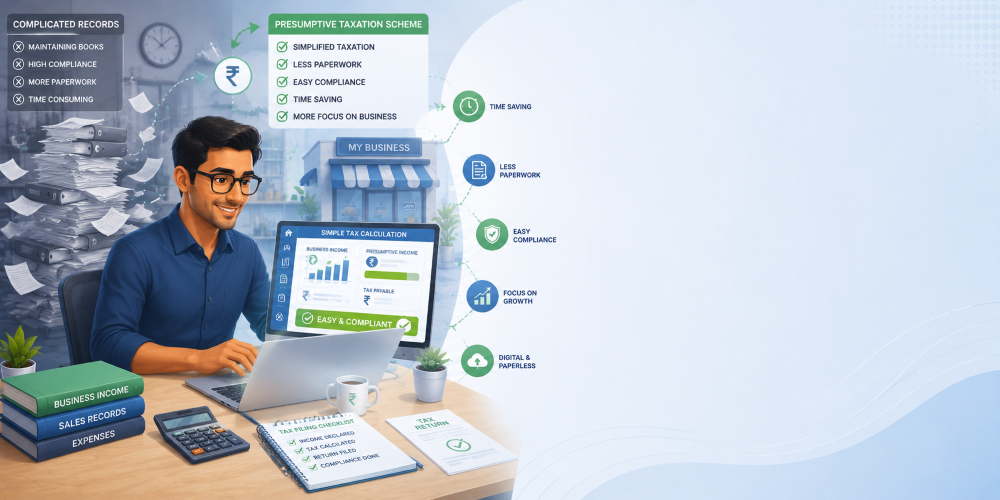
Running a small business comes with enough to manage already, without having to maintain detailed account books just to file an income tax return. This is exactly the problem Section 44AD of the Income Tax Act was designed to solve. It allows small business owners to pay tax on a fixed, presumed percentage of their turnover, without keeping detailed books of account and without getting their accounts audited. For traders, shopkeepers, small manufacturers, and other small business owners, this can make tax filing dramatically simpler. This article explains, in plain language, who can use Section 44AD, how the tax is calculated, what the turnover limits are for this year, and the important rules and traps to be aware of.
What Is Section 44AD
Section 44AD is a presumptive taxation scheme. Instead of calculating actual profit by deducting every business expense from income, the law simply presumes a fixed percentage of your total turnover as your taxable profit, regardless of what your actual expenses were.
The scheme exists to reduce the compliance burden on small businesses, who would otherwise need to maintain detailed books and, in many cases, get those books audited every year. Under Section 44AD, that requirement is removed entirely, as long as you stay within the scheme’s conditions.
Who Can Use Section 44AD
The scheme is available to what the law calls an “eligible assessee” running an “eligible business.” In simple terms, this means resident individuals, Hindu Undivided Families (HUFs), and partnership firms, as long as the firm is not a Limited Liability Partnership. Companies and LLPs cannot use this scheme.
There are also some exclusions worth knowing. The scheme does not apply to anyone carrying on a profession that is separately covered under Section 44AA, such as doctors, lawyers, engineers, architects, and chartered accountants. These professionals have their own presumptive scheme under a different section, Section 44ADA, with different rates and limits. Section 44AD also does not apply to anyone earning income in the nature of commission or brokerage, or to anyone running an agency business. Businesses involved in plying, hiring, or leasing goods carriages are also excluded, since they fall under a separate presumptive provision of their own.
One more condition is worth flagging: to use Section 44AD, you must not have claimed certain other tax deductions in the same year, including deductions under sections like 10A, 10AA, 10B, or 10BA, or deductions under Chapter VIA relating to certain specified incomes. For most ordinary small businesses, this condition rarely comes into play, but it is worth checking if your business has any special tax-exempt income.
Turnover Limits for FY 2025-26 (AY 2026-27)
This is the part most business owners want to know first: how big can your business be and still use this scheme. The turnover limit is Rs 3 crore for FY 2025-26 if 95 percent of the receipts are in digital form, such as bank transfers, UPI, cheques, NEFT, RTGS, or other electronic modes. If digital receipts make up less than 95 percent of total receipts, the limit drops to Rs 2 crore.
This digital-receipts condition is an important incentive built into the scheme. A business that mostly deals in cash is capped at a lower turnover limit than one that accepts most of its payments digitally, which nudges small businesses toward more transparent, traceable payment methods.
It is worth being precise about how “digital” is defined here, since the law is also strict about what does not count. According to the law itself, payment received by an account payee cheque, an account payee bank draft, or through electronic clearing or other prescribed electronic modes counts toward the digital limit. However, if a cheque or bank draft is received but it is not an account payee instrument, it is treated as a cash receipt for this calculation, even though it technically passed through a bank. This distinction trips up many small business owners who assume any cheque automatically counts as a digital receipt.
How Much Tax Do You Pay Under Section 44AD
The presumed profit rate depends entirely on how the turnover was received.
For turnover received through cash or non-digital modes, the presumed profit is 8 percent of that turnover.
For turnover received through digital modes such as bank transfer, UPI, NEFT, RTGS, or an account payee cheque or draft, the presumed profit is a lower 6 percent of that turnover.
This means a single business can actually have a mix of both rates applied within the same year, calculated separately on the digital and cash portions of its turnover. A business earning Rs 80 lakh in a year, with Rs 65 lakh received digitally and Rs 15 lakh received in cash, would calculate Rs 65 lakh at 6 percent, working out to Rs 3.9 lakh, and Rs 15 lakh at 8 percent, working out to Rs 1.2 lakh, giving total presumed income of Rs 5.1 lakh for the year.
This presumed income, once calculated, is then added to any other income you have, such as salary, interest, or rental income, and taxed at your normal income tax slab rates. There is no separate flat rate for presumptive business income itself; it is simply treated as part of your total income for the year.
It is also worth knowing that you are allowed to declare a higher profit than the presumed 8 or 6 percent if your actual profit was genuinely higher. The scheme sets a floor, not a ceiling.
No Separate Deduction for Expenses
A central feature of this scheme is that once you opt in, you cannot claim any separate deduction for business expenses, whether that is rent, salaries to staff, electricity, raw materials, or anything else. The law treats the deduction for these expenses as already factored into the 8 percent or 6 percent figure. You cannot deduct expenses on top of the presumed income, nor can you claim depreciation separately, since depreciation is also deemed to have already been accounted for.
The one specific exception is for partnership firms using this scheme. Partnership firms under Section 44AD can still claim a deduction for remuneration and interest paid to partners, even while using the presumptive scheme. This is a useful carve-out for small partnership businesses, since salary and interest paid to working partners can still reduce the firm’s taxable income even under presumptive taxation.
No Books of Account, No Audit Required
This is the main attraction of Section 44AD for most small business owners. Businesses that opt for this scheme are not required to maintain the detailed books of account otherwise mandated under Section 44AA, and they are not required to get those accounts audited under Section 44AB. This alone can save a meaningful amount of compliance cost and time every year, particularly for sole proprietors and small traders who would otherwise need to engage an accountant for regular bookkeeping.
The simplified ITR-4 (Sugam) form is used to file the return under this scheme, with a dedicated section where the turnover, the applicable percentage, and the resulting presumed income are entered, without the need for a detailed profit and loss schedule.
The Five-Year Lock-In Rule
This is the part of Section 44AD that catches the most business owners off guard, and it is worth understanding clearly before opting in.
If you declare your income under this scheme in a particular year, and then in any of the next five years you declare profit below the required 8 or 6 percent (in other words, you step out of the presumptive method), you become ineligible to use Section 44AD again for the next five assessment years after that. This is a firm lock-out, not a minor inconvenience.
A Practical Example
Consider a small business owner running a retail shop, with a turnover of Rs 1.5 crore in FY 2025-26, almost entirely received through UPI and bank transfers. Since digital receipts comfortably exceed 95 percent of turnover, the 6 percent rate applies. The presumed taxable income works out to Rs 9 lakh for the year. This Rs 9 lakh is then added to any other income the owner has, such as interest from a savings account or rental income, and tax is computed on the total at the applicable slab rates. No separate accounting of actual expenses, no audit, and a comparatively simple ITR-4 filing complete the process.
This kind of straightforward filing has made Section 44AD genuinely useful for thousands of small traders and shop owners, including a large number of small and medium businesses operating out of Gurgaon’s commercial markets and trading hubs, where digital payments through UPI have become the norm for most retail and wholesale transactions in recent years.
Things to Check Before Opting In
Before choosing this scheme, it is worth comparing your actual profit margin against the presumed 6 or 8 percent rate. If your real profit margin is genuinely lower than this, for instance in a low-margin trading business, opting for Section 44AD could mean paying tax on income you have not actually earned. In such cases, filing under the normal provisions, with actual books of account, may result in lower tax, even with the additional compliance involved.
It is also worth remembering the five-year consequence before opting in for the first time. Once you start, stepping back out early because of a genuinely lower-profit year can have a longer-term compliance cost, so this decision is best made with a clear sense of how stable your turnover and margins are likely to be over the next several years.
Frequently Asked Questions
1. Who is eligible for Section 44AD?
Resident individuals, Hindu Undivided Families, and partnership firms (excluding LLPs) running an eligible business, with turnover up to Rs 2 crore, or Rs 3 crore if at least 95 percent of receipts are digital. Professionals such as doctors, lawyers, and architects are not eligible under this section and must instead consider Section 44ADA.
2. What is the presumed profit rate under Section 44AD?
8 percent of turnover received in cash or non-digital modes, and 6 percent of turnover received through digital modes such as bank transfer, UPI, or account payee cheques and drafts.
3. Can I claim business expenses separately under this scheme?
No. The 8 or 6 percent presumed income is treated as already accounting for all business expenses and depreciation. The only exception is for partnership firms, which can still deduct remuneration and interest paid to partners.
4. Do I need to maintain books of account under Section 44AD?
No. One of the main benefits of this scheme is that you are not required to maintain detailed books of account under Section 44AA, nor get them audited under Section 44AB, as long as you remain eligible and continue to declare income under the scheme.
5. What happens if I declare profit lower than 8 or 6 percent?
If you declare profit below the presumed rate in any of the five years after first opting into the scheme, you lose the ability to use Section 44AD for the next five assessment years. If your income exceeds the basic exemption limit in that year, you will also need to maintain books of account and get a tax audit done.
6. Can a business with high cash transactions still use Section 44AD?
Yes, as long as turnover does not exceed Rs 2 crore. The higher Rs 3 crore limit is available only when digital receipts make up at least 95 percent of total receipts during the year.
7. Which ITR form is used to file under Section 44AD?
ITR-4 (Sugam) is used by individuals, HUFs, and partnership firms opting for presumptive taxation under Section 44AD, provided their total income for the year is up to Rs 50 lakh and other ITR-4 conditions are met. If total income exceeds this, ITR-3 must be used instead, even while still computing business income on a presumptive basis.
8. Can professionals like doctors or consultants use Section 44AD?
No. Professionals covered under Section 44AA, such as doctors, lawyers, architects, engineers, and chartered accountants, cannot use Section 44AD. They have a separate presumptive scheme under Section 44ADA, with a 50 percent presumed profit rate and a lower turnover threshold.